Showing posts with label medicine. Show all posts

Tuesday, 11 December 2007

UCLH A+E: Open day 6/12/07


Among the pallid faces and the heads in hands is a bubbly American woman who has staple-gunned a piece of wood to her thumb and a Scottish bloke with a suitcase.


He’s trying to chat up a girl with broken fingers – the result of a karate chopping nephew.

It’s University College Hospital’s annual open day but around the corner from the main entrance, where Gloria Hunniford is turning on the Christmas lights, it’s just another day in A + E.

London’s Tottenham Court Road is famous for its technology retailers.

Since 2005, the top end of this gadget Mecca has also been an appropriate home for one of the capital’s newest hospitals.

Today is a chance for healthy members of the public to find out what goes on behind closed doors inside this modern hospital.

UCH is big and glassy, woven together with white-painted steel.

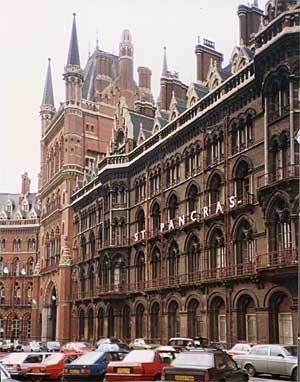
It’s the antithesis to the gothic and ultra intricate St. Pancras station, not far away down the Euston Road.

As I stand outside the huge atrium that forms the main entrance to the hospital, a couple of men in suits are scurrying around studying surfaces for imperfections - “That needs cleaning, that needs polishing, and when is this getting painted?”

Today the sun seems to have barely lifted its shoulders above the horizon before going back to bed.

It’s gloomy outside but the huge Christmas tree and genuinely amazing carol singers help to brighten the spirits inside.

Their voices soar in the cathedral-like space.

A queue has formed in front of the table where tours of the different departments can be booked.

Pensioners are battling for slots on the most popular tours and when I am given a pass to A+E without queuing, my explanation that I am writing an article is met with unsatisfied glares through wrinkled eyes.

Blood, guts, vomit, chest-pounding heroics and a conveyor belt of lives brought back from the brink – this is emergency medicine, at least if you watch a lot of TV it is.

The public perception of what goes on behind closed doors in A+E makes this chance to tour the department a popular one.

Dr. Adeyoke, an A+E registrar at UCH somewhat dispels the myth that patients are regularly brought back from the dead after being zapped with electricity.

Indeed his single most memorable event after two years of working at UCH was a scenario like this.

“A young, middle-aged man came in with pulseless electrical activity”, a particularly bad kind of heart attack, “ and working as a team we managed to stabilise him and get him to intensive care”, he said.

Unrealistic expectations are sometimes placed upon A+E doctors as we imagine them flying around the department with their chests puffed out and a white coat flapping in the wind like a super-hero’s cape.

These people are humans and humans inevitably make mistakes.

Dr. Adeyoke says, “The hardest part of the job is the time constraints. There is such pressure and we can be prone to errors as a result”.

Back in the hospital atrium, the carol singers have finished and Kokila Gillett, a solo musician is performing traditional Indian music.

Before the tour begins, I drag myself away from the festivities and take in the delights of the A+E waiting room.

Facial expressions range from boredom to wincing pain, with not much in between apart from a beaming smile on the face of the cleaner who is gently chuckling to herself as she mops the floor.

From behind protective glass, a receptionist loudly asks a sheepish looking man, “When did you last open your bowels?”

The Scottish man with the brightly coloured suitcase has just arrived on a train from Dundee.

He sits down near to the girl with the broken fingers who has suffered at the hands of an overzealous relative, playing ninja.

“Are you married, love?” he asks, thirty seconds into their conversation.

She gently rebuffs him in a cockney accent that an American tourist would queue up to hear.

With this soap opera playing out around me, I’m a little aggrieved that the tour is about to start but I reluctantly join the group anyway.

We silently traipse around the department behind our amiable tour guide, trying not to get in the way.

Doctors cluster around light-boxes, carefully studying x-rays for signposts towards a diagnosis.

The atmosphere is industrious but calm.

I have my fingers crossed for somebody to come bursting through the swing-doors from the ambulance bay with a knife sticking from their back or something suitably dramatic.

No such luck. Our tour through the slick department passes without incident.

I remember my chat with Dr. Adeyoke - “It’s not like it is on TV”, he assured me.

Perhaps that’s because he doesn’t spend much time in the waiting room.

Great characters played out romance, comedy, pain and suffering in my thirty minutes there.

Tuesday, 4 December 2007

Doing a journalism fing.

Everybody knows that students are idiots and don’t have a clue about anything.

Students - idiots.


This is a fact and I’m not going to dispute it, particularly as I am one and there are loads of words underneath *here* to back this fact up.

Having been a student of medicine and now journalism, I’ve noticed that the two groups share a belief that they’re going to “make a difference”.

Doctors are going to relieve suffering and journalists are going to expose corrupt politicians and stuff.

I’m going to try desperately hard not to “make a difference”, especially in medicine because I’m worried that I’m more likely to contribute to some kind of major catastrophe than find the cure for cancer – I’m that kind of difference maker.

The plan is to play it safe, nice and safe.

Which has just reminded me of a poll I saw a while back about the most trusted professions in the UK.

Doctors are the most trusted professionals and journalists the least.

This is perfect as my two backgrounds should counterbalance one another in the trust stakes and leave me half way up the league – nice and safe.

Anyway, before that brief tangent, what I was going to say was that students have an admirable notion within them that they are going to do something positive.

That’s before the medics mutate into Harold Shipman and the journos become manipulative bastards with an agenda.

Maybe that’s a little extreme but if you’re going to make a point, you may as well make it sensational. I think.

This morning, I put on my rose-tinted spectacles that had a 20% student discount and went off to do what I consider my first bit of real journalism.

Don’t get me wrong, that doesn’t mean I asked Gordon Brown fourteen times what his favourite colour is or anything hard hitting like that, I just mean that I went out and spoke to some people before writing about it.

My reaction to this is what makes me a naïve moron.

I just couldn’t help feeling really good about the world afterwards and I’m sure that’s not what cynical journalists are supposed to think.

On my course, we had to write a piece that was based loosely around Christmas shopping.

I decided to do mine on what London’s foreign population buy for their Christmas dinners and so I went round to some of the cafés and restaurants near me to ask the people who work there.

My first stop was to an Italian café called Vesuvio where the chef warmly told me all about a traditional Christmas in Italy despite the fact that it was lunchtime and he was busy.

They also brought me a coffee which I was told was on the house when I went to pay for it – talk about perks of the job!

Later on I went to the amusingly named “Gung-Ho” Chinese restaurant

Eric chatted to me there and what a nice man Eric was.

I just wanted to share with you a devastatingly good air travel tip he gave me.

Oasis are a low budget airline that fly from London to Hong Kong for as little as £99 if you book it early enough.

I reckon if I take fewer showers and maybe flush the loo less, I could reduce my carbon footprint enough to jet off to Asia three times a year, guilt free.

Woop di doo.

Thursday, 8 November 2007

Medical Journalism Awards

On Monday night, I attended the Medical Journalism Awards.

Being the only person at Westminster University doing medical journalism, I was invited by my tutor to come along on my own to gorge myself on canapes and free booze.

If you're wondering whether it's possible to "gorge" yourself on tiny canapes, I can confirm that yes, it is.

Without wanting to detract from the awards themselves, I learnt some valuable life skills on Monday, mostly revolving around eating canapes.

As I arrived, it was easy enough to get myself a glass of wine because they were given to us on the way in.

I found it equally easy to get my glass filled up when it was empty.

However, despite occasionally spotting distant plates of food, wafting among the guests like butterflies (butterflies that I wanted to eat, desperately), trying to actually get my hands on some grub felt like chasing rainbows (tasty rainbows - like skittles but not like skittles, more like burgers).

The main reason I was told to come along to the awards was so that I could 'network'.

My current situation was making this difficult as the mighty booze/food-scales-of-dignity were becoming alarmingly unbalanced due to an empty stomach.

Mild panic set in as it seemed that the food had dried up.

Looking around, all I could see were empty plates or dead, moldy, inedible butterflies if you prefer.

The booze kept coming.

Now, I know what you're thinking - "why don't you just stop drinking?"

Ok, good idea but ringing in my ears were Andrew Marr's words - "Journalism and alcohol go together like betting and racehorses".

Whether this was criticism of his profession or advice to aspiring hacks, I can't be certain but I thought it was best to play safe and get really pissed.

Anyway, just in time, loads more food started pouring into the elegant hall where the awards were held and this time I was ready to stop being polite and elbow my way to the nosh.

I think this took the edge off of my slurring and I could start talking to potential employers again.

Some thoroughly delightful people who had done the Medical Journalism course at Westminster were there and one of them was Ashley Mckimm, who started the website JuniorDr.com.

He has already sent me an email offering me some work which is rather splendid.

It just made me think about the opportunities that this course offers, having seen what former students have gone on to do and also the chances I am already getting to write in professional publications.

If anyone comes across this blog after googling medical journalism or something, feel free to get in touch to ask me what the course is like.

It's a wonderful opportunity to do something completely different away from your medical school and even if you don't become a journalist, it will give you great writing and presentation skills which are invaluable to a doctor.

I'll try and write a little bit more about the great stuff we are doing on the course in the future.